Mastering Conversion Optimization: Your Guide to Higher Website Performance

Albert Pak
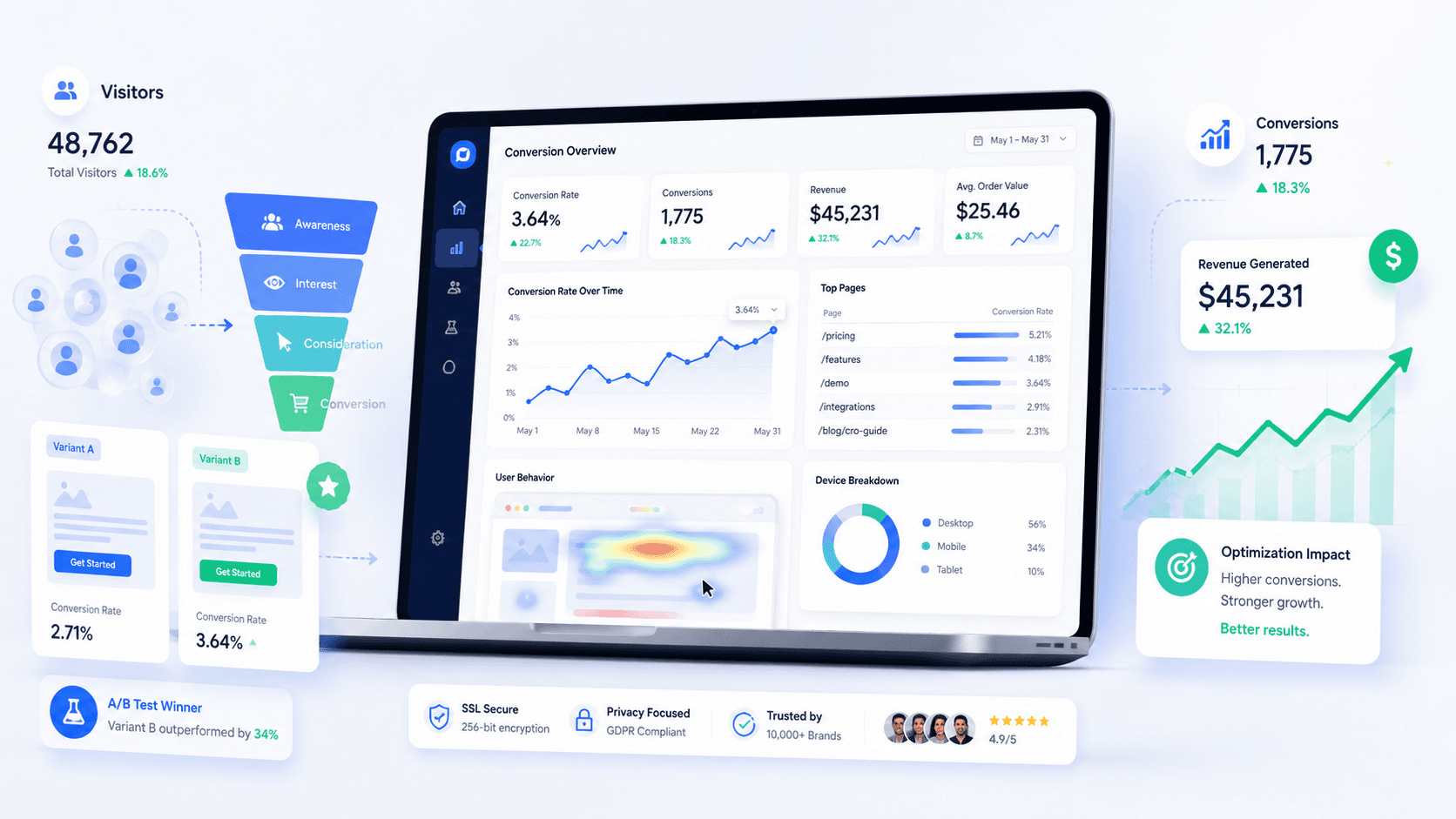
In the competitive digital marketplace, attracting visitors to your website is only half the battle. The real challenge—and the key to sustainable growth—lies in turning that traffic into tangible business results. This is the core of conversion rate optimization (CRO), a systematic process for increasing the percentage of website visitors who take a desired action. It’s the art and science of making your existing traffic more valuable.
This guide provides a comprehensive overview of the conversion rate optimization process, from foundational principles to actionable strategies. You will learn how to diagnose website weaknesses, understand user behavior, and implement data-driven changes that boost performance. By the end, you'll be equipped to transform your website from a digital brochure into a powerful engine for revenue and customer acquisition, maximizing the return on every marketing dollar spent.
- What is CRO?: Conversion Rate Optimization (CRO) is the practice of increasing the percentage of users who perform a desired action on a website, such as making a purchase or filling out a form.
- Why it Matters: CRO helps you maximize the value of your existing traffic, leading to higher revenue, better ROI on marketing spend, and a superior user experience.
- Core Principles: Effective CRO is built on a user-centric approach, data-driven decision-making, and a commitment to continuous, iterative improvement.
- Key Strategies: High-impact tactics include A/B testing, personalization, reducing friction in user journeys, clarifying your value proposition, and building trust with social proof.
- The Process: A structured CRO program involves four key steps: research and data collection, hypothesis formulation, experimentation, and analysis with implementation.
- E-commerce & SEO: CRO is critical for e-commerce success (optimizing product pages and checkouts) and works hand-in-hand with SEO to improve landing page performance for organic traffic.
What is Conversion Rate Optimization (CRO) and Why is it Essential?
Conversion Rate Optimization (CRO) is a systematic process of increasing the percentage of website visitors who take a specific, desired action. This "action" is known as a conversion. Understanding CRO begins with a clear definition of what a conversion means for your business. It's not always a direct sale. A conversion can be any valuable user action, such as submitting a lead form, signing up for a newsletter, downloading an ebook, starting a free trial, or making a purchase.
The "conversion rate" is calculated by dividing the number of conversions by the total number of visitors and multiplying by 100. For example, if 1,000 people visit your landing page and 20 of them sign up for your webinar, your conversion rate is 2%. This metric is a direct measure of your website's effectiveness. The fundamental importance of CRO is that it allows you to increase revenue and profitability without needing to attract more traffic. You get more value from the visitors you already have, which enhances the return on investment (ROI) for all your marketing efforts.
While CRO is a distinct discipline, it complements other digital marketing strategies like Search Engine Optimization (SEO) and paid advertising. SEO and paid ads focus on driving traffic to your site; CRO focuses on converting that traffic once it arrives. A high-ranking page (good SEO) that doesn’t convert is a missed opportunity. Likewise, paying for clicks (PPC) that don't lead to conversions is a waste of budget. By improving the user experience and understanding customer behavior, CRO makes every visitor more valuable, amplifying the success of your other marketing channels.
Key Principles and Strategies for Effective CRO
A successful conversion rate optimisation strategy is guided by several foundational principles. First and foremost is a commitment to user-centric design; every optimization effort should aim to improve the user's journey and make it easier for them to achieve their goals. Second is a reliance on data-driven decisions. Instead of relying on guesswork or intuition, CRO uses analytics, user feedback, and testing to make informed choices. Finally, CRO is a process of continuous improvement. It is not a one-time project but an ongoing, iterative cycle of testing and refinement that leads to sustained growth.
Building on these principles, several high-impact strategies are central to website conversion optimization. The most well-known is A/B testing and multivariate testing. A/B testing involves creating two versions of a page (a control and a variation) and showing them to different segments of your audience to see which one performs better. Multivariate testing takes this further by testing multiple variable changes simultaneously. These methods provide concrete evidence for which changes positively impact user behavior.
Other essential strategies include personalization, which involves tailoring website content, offers, and experiences to specific user segments based on their behavior or demographics. Friction reduction is another critical tactic; this involves identifying and eliminating obstacles in the conversion path, such as overly long forms, confusing navigation, or unexpected shipping costs. A clear and compelling value proposition is also vital, ensuring visitors immediately understand why they should choose your product or service. Lastly, building trust is paramount. This is achieved through social proof and trust signals, like customer testimonials, case studies, security badges, and positive reviews, which reassure potential customers and build their confidence.
A Practical Guide to the CRO Process
To effectively learn conversion rate optimization, it's essential to follow a structured, repeatable process. This framework ensures that your efforts are based on data and are geared toward achieving measurable improvements. The CRO process can be broken down into four distinct steps.
Step 1: Research and Data Collection This initial phase is about understanding how users currently interact with your website and identifying potential areas for improvement. It combines quantitative and qualitative methods. Web analytics tools like Google Analytics are used to analyze user behavior patterns, identify high-traffic pages with high exit rates, and map out conversion funnels to see where users drop off. This data is supplemented with qualitative insights from tools like heatmaps and session recordings, which visualize where users click and scroll. User surveys, customer feedback forms, and interviews provide direct insight into user frustrations and motivations.
Step 2: Hypothesis Formulation Based on the data collected, the next step is to formulate a clear, testable hypothesis. A strong hypothesis identifies a specific problem, proposes a solution, and predicts a measurable outcome. For example, a hypothesis might be: "Changing the call-to-action (CTA) button text on our product page from 'Buy Now' to 'Shop Now' will increase clicks by 15% because 'Shop Now' implies a lower-commitment browsing experience." This creates a focused premise for your experiment.
Step 3: Experimentation and Testing With a hypothesis in place, you can design and run an experiment, typically an A/B test or a multivariate test. Using dedicated platforms like Optimizely, VWO, or Google Optimize, you create a variation of your page that reflects the proposed change. The testing software then splits your website traffic between the original version (the control) and the new version (the variation), tracking which one achieves a higher conversion rate. It's crucial to run the test long enough to achieve statistical significance, ensuring the results are reliable and not due to random chance.
Step 4: Analysis and Implementation Once the test concludes, you analyze the results to determine if your hypothesis was correct. If the variation produced a statistically significant lift in conversions, the change should be permanently implemented on the website. Equally important is to document the learnings from the test, whether it won or lost. Understanding why users responded a certain way provides valuable insights that will inform future optimization efforts, making the entire conversion rate optimization process a continuous learning loop.
CRO in Action: E-commerce, SEO, and Real-World Examples
The principles of conversion rate optimization are applied differently across various business contexts, with e-commerce and SEO being two areas where it delivers significant impact. For an e-commerce conversion optimization strategy, the focus is on streamlining the path from product discovery to purchase. This includes optimizing product pages with high-quality images, compelling descriptions, clear pricing, and prominent social proof like customer reviews. A frictionless checkout process is also critical; tactics like offering guest checkout, displaying a progress indicator, being transparent about shipping costs upfront, and showing secure payment badges can dramatically reduce shopping cart abandonment.
In the context of SEO conversion rate optimization, the goal is to ensure that the traffic you earn from search engines converts effectively. This involves aligning your landing page content precisely with the user's search intent. If someone searches for "best running shoes for beginners," the landing page should deliver exactly that, not a generic shoe category page. Furthermore, technical factors that influence both SEO and user experience, such as fast page load speeds and mobile responsiveness, are crucial for keeping visitors engaged and reducing bounce rates. A positive user experience signals to search engines that your page is valuable, which can in turn support your rankings.
Real-world conversion rate optimization examples highlight the power of small, data-driven changes:
- Simplifying Forms for Higher Leads: A B2B software company discovered through analysis that its long lead-generation form was a major point of friction. By reducing the number of required fields from 11 to just 4, they saw a 120% increase in form submissions without a drop in lead quality.
- CTA Copy Change Doubles Trials: The travel deals company Going achieved a 104% month-over-month increase in premium trial sign-ups simply by running an A/B test on their call-to-action button text. This shows how a small wording change can have a massive impact on user motivation.
- Optimizing for Mobile Drives In-Store Sales: New Balance Chicago used mobile-optimized landing pages to connect their digital ads to physical store visits. By creating a seamless experience for mobile users, they drove 200% more in-store sales compared to previous campaigns.
These examples underscore that CRO is not about radical redesigns but about a persistent, analytical approach to understanding and improving the customer journey. Investing in a continuous conversion rate optimisation strategy is a direct investment in business growth and a deeper connection with your customers.
Conclusion: CRO as a Cornerstone of Sustainable Growth
Mastering conversion optimization is no longer a luxury reserved for top-tier corporations; it is a fundamental necessity for any business seeking to thrive in the digital landscape. Simply driving more traffic to an underperforming website is an inefficient and costly strategy. The true path to sustainable growth lies in maximizing the value of every visitor you already have. By embracing the principles of user-centric design, data-driven analysis, and iterative testing, you transform your website from a static asset into a dynamic, high-performance conversion tool. It’s about working smarter, not just harder, to achieve your business objectives.
The journey begins with a commitment to understanding your audience on a deeper level—their needs, their pain points, and their behavior. From there, the structured process of research, hypothesis, testing, and implementation provides a clear roadmap for making impactful improvements. Whether you are optimizing an e-commerce checkout, a B2B lead form, or a content landing page, the core tenets remain the same: listen to your data, test your assumptions, and never stop improving. Start by identifying one area of friction in your user journey today. A single, well-executed A/B test could unlock significant revenue and provide the momentum needed to build a culture of continuous optimization within your organization.
Frequently Asked Questions (FAQ)
What is a good conversion rate? A "good" conversion rate varies significantly by industry, traffic source, and the type of conversion being measured. While some reports suggest a median conversion rate across all industries is around 6.6%, it's more productive to benchmark against your own historical performance and focus on continuous improvement rather than a universal number.
How long should you run a CRO test? A CRO test should run long enough to achieve a statistical significance level of at least 95% and to capture a full business cycle (e.g., at least two to four weeks) to account for fluctuations in user behavior. The required duration depends heavily on your website's traffic volume and the conversion rate of the page being tested.
What is the difference between CRO and SEO? SEO (Search Engine Optimization) focuses on increasing the quantity and quality of traffic to your website from organic search results. CRO (Conversion Rate Optimization) focuses on increasing the percentage of that traffic that takes a desired action. They are complementary; SEO brings visitors in, and CRO helps convert them.
What are some common CRO tools? Common CRO tools include web analytics platforms like Google Analytics for data collection, user behavior tools like Hotjar for heatmaps and session recordings, and A/B testing platforms like Optimizely, VWO, and Google Optimize to run experiments.
Can small changes really make a big difference in conversions? Absolutely. Numerous case studies show that seemingly small changes—like altering the text on a CTA button, removing a single form field, or making a free shipping offer more prominent—can lead to significant, double-digit increases in conversion rates.
Is CRO a one-time project or an ongoing process? CRO is an ongoing, iterative process. Customer expectations and market dynamics are constantly changing, and there is always room for improvement. A continuous cycle of testing and optimization is the key to long-term success and sustained growth.
How do I get started with conversion rate optimization? Start by analyzing your existing data in a tool like Google Analytics to identify your most important pages and find where users are dropping off in the conversion funnel. Use this information to form a simple, testable hypothesis and run your first A/B test on a high-traffic page.