How to Optimize for Conversions: A Comprehensive Guide for Businesses

Albert Pak
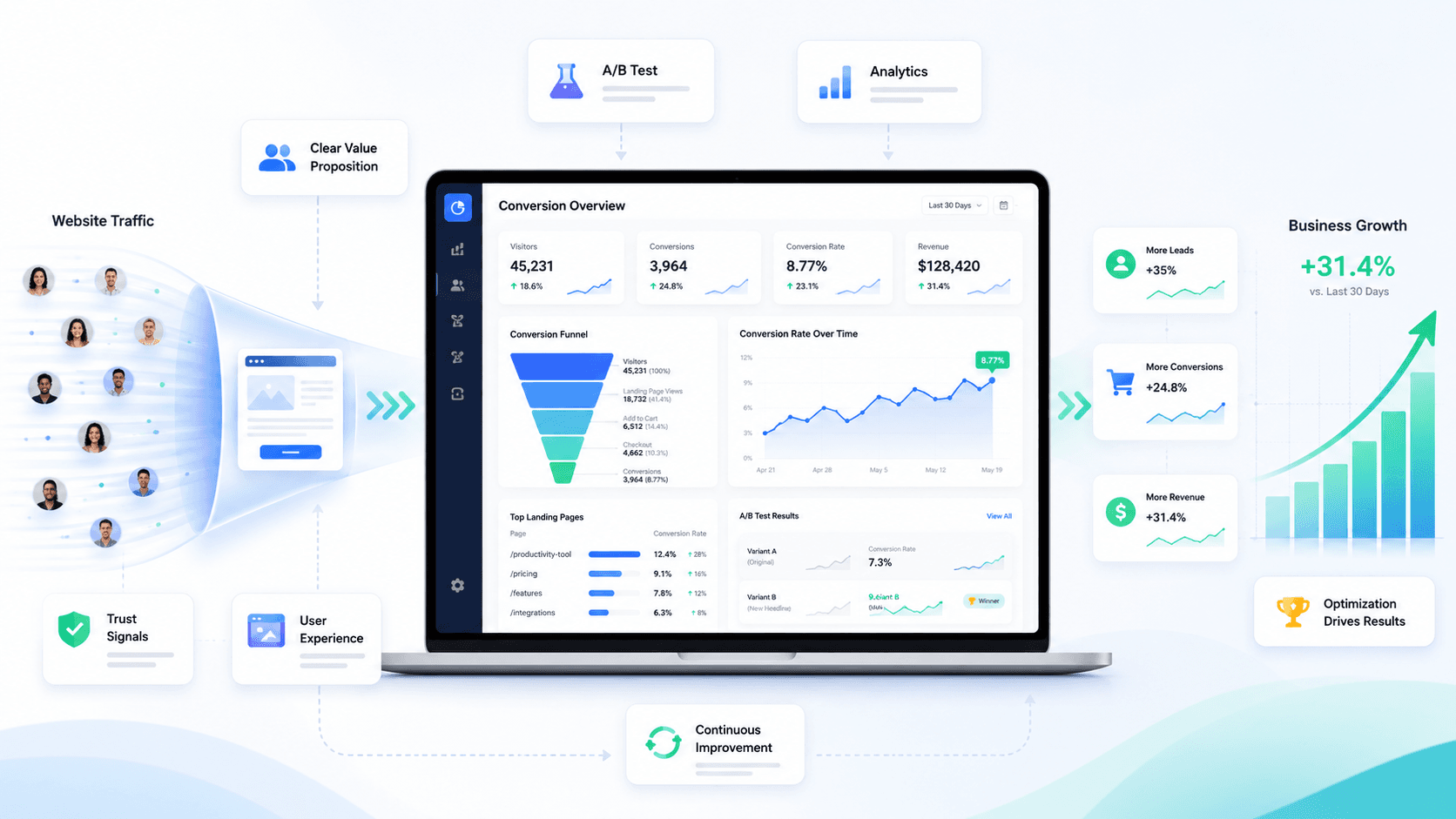
In the digital marketplace, attracting visitors to your website is only half the battle. The real challenge—and where true business growth lies—is turning those visitors into customers. This is the essence of conversion rate optimization (CRO), a discipline dedicated to enhancing your website to increase the percentage of users who take a desired action. Simply put, it’s about getting more value from the traffic you already have.
To "optimize for conversions" means systematically refining every element of your user's journey to make it as seamless and persuasive as possible. This goes far beyond just securing a sale. A conversion can be any valuable action: a lead form submission, a newsletter signup, a content download, or a demo request. For any business operating online, mastering CRO is not just a good idea; it's a critical component of profitability and a powerful competitive advantage.
This comprehensive guide will walk you through the entire process of site conversion optimization. We will cover everything from the foundational principles of user experience and trust-building to actionable strategies for landing pages, A/B testing, and analytics. By the end, you'll have a clear roadmap to transform your website into a high-performing engine for business growth.
Key Takeaways
- What CRO Is: Conversion Rate Optimization (CRO) is the systematic process of increasing the percentage of website visitors who complete a desired action, such as making a purchase or filling out a form.
- Beyond Traffic: CRO focuses on maximizing the value of your existing traffic, improving ROI without necessarily increasing your advertising spend.
- User Experience is Key: A positive user experience (UX), characterized by fast load times, intuitive navigation, and mobile-friendly design, is the foundation of high conversion rates.
- Trust is Non-Negotiable: Building credibility through social proof, security signals like SSL certificates, and professional design is essential for persuading users to convert.
- Data-Driven Decisions: Effective CRO relies on continuous A/B testing and data analysis, not guesswork. Tools like Google Analytics and heatmaps provide the necessary insights.
- Avoid Common Pitfalls: Many businesses fail at CRO by ignoring qualitative user feedback, making assumptions instead of testing, and not developing detailed buyer personas.
- It's a Marathon, Not a Sprint: CRO is an ongoing, iterative process of analysis, hypothesis, testing, and implementation that compounds benefits over time.
Understanding Site Conversion Optimization: The Foundation of Digital Growth
At its core, site conversion optimization is about making your website more effective. While generating traffic through SEO, paid ads, and social media is crucial, it's what you do with that traffic that ultimately determines your success. This is where a deep understanding of Conversion Rate Optimization (CRO) becomes a game-changer for any digital growth strategy.
What is Conversion Rate Optimization (CRO)?
Conversion Rate Optimization (CRO) is the systematic process of increasing the percentage of website visitors who take a specific, desired action. This action, known as a "conversion," can vary widely depending on business goals. For an e-commerce site, the primary conversion is a sale. For a B2B company, it might be generating a lead by having a user fill out a contact form. Other common conversion goals include subscribing to a newsletter, downloading a whitepaper, signing up for a free trial, or creating an account.
It's vital to distinguish between traffic generation and conversion optimization. Traffic generation focuses on bringing more people to your website. CRO, on the other hand, focuses on maximizing the value of the visitors you already have. It's about efficiency and effectiveness, ensuring that every click has the highest possible chance of turning into a valuable business outcome.
Why is CRO Essential for Business Growth?
Implementing CRO best practices offers substantial benefits that directly impact your bottom line. The most significant financial advantage is achieving a higher return on investment (ROI). By improving your conversion rate, you can generate more leads or sales from the same amount of traffic, which means your marketing dollars work harder. This allows you to grow revenue without constantly needing to increase your ad spend.
Furthermore, the process of CRO inherently leads to a deeper understanding of your customers. By analyzing user behavior, testing different messaging, and gathering feedback, you gain invaluable insights into your audience's motivations, pain points, and preferences. This knowledge not only helps you optimize your website but also informs your product development, marketing messaging, and overall business strategy. Ultimately, a highly optimized site provides a superior user experience, which builds trust, fosters loyalty, and creates a significant competitive advantage in a crowded digital landscape.
Key Principles for Maximizing Website Conversions
Before diving into specific tactics, it's crucial to grasp the foundational principles that underpin every successful conversion strategy. These pillars—user experience, trust, and clarity—work together to create an environment where visitors feel comfortable, confident, and compelled to take action. Mastering these elements is the first step toward significant website conversion improvement.
User Experience (UX) as a Conversion Driver
User experience isn't just about aesthetics; it's about how easily and enjoyably a visitor can achieve their goal on your site. A frictionless UX is a powerful conversion driver. This starts with intuitive navigation and a clear site architecture that allows users to find what they're looking for with minimal effort. If users are confused or frustrated, they will leave. In today's mobile-centric world, a mobile-first design is non-negotiable. Your website must provide a seamless, responsive experience across all devices, from desktops to smartphones.
Perhaps one of the most critical, yet often overlooked, aspects of UX is page load speed. User patience is incredibly thin. Studies consistently show that even a one-second delay in page load time can lead to a significant drop in conversions. Faster websites see lower bounce rates and higher engagement, directly translating into more conversions and revenue. Prioritizing speed is not just a technical task; it's a core conversion optimization strategy.
The Role of Trust and Credibility
People do business with companies they trust. Your website must actively build that trust from the moment a user lands on it. One of the most effective ways to build credibility is through social proof. Displaying testimonials from satisfied clients, positive reviews, detailed case studies, and logos of well-known customers provides third-party validation that your offerings are valuable and legitimate.
Security indicators are equally important in establishing a sense of safety. An SSL certificate (indicated by "https://" and a padlock icon in the browser) is a baseline requirement, assuring users that their data is encrypted and secure. Prominently displaying privacy policies, trust seals, and money-back guarantees further alleviates anxiety, particularly during checkout or form submission. Finally, never underestimate the power of professional design and error-free content. A polished, modern design with high-quality images and well-written, typo-free copy signals competence and attention to detail, reinforcing that your business is credible and trustworthy.
Clarity and Value Proposition
A visitor should understand what your business offers and why it's the best choice within seconds of arriving on your site. This is achieved through a clear and compelling value proposition. Your headline is the first thing most visitors will read; it must be powerful and grab their attention by communicating the primary benefit you offer. It's crucial to articulate the benefits of your product or service, not just its features. A feature is what your product *is* (e.g., "a 500GB hard drive"), while a benefit is what the customer *gets* (e.g., "store all your family photos in one place").
Simplicity is key. Avoid industry jargon and complex language that could confuse your audience. Break down complex information into easily digestible chunks using bullet points, icons, and clear headings. Your goal is to ensure that every visitor, regardless of their prior knowledge, can quickly comprehend the value you provide and see a clear path to solving their problem with your solution.
Actionable Strategies to Optimize Your Site for Conversions
With a solid foundation in place, you can begin implementing specific, actionable strategies to boost your conversion rates. These tactics focus on critical touchpoints in the user journey, from the first impression on a landing page to the final click of a call-to-action. By systematically refining these elements through testing and analysis, you can create a powerful and persuasive path to conversion.
Optimizing Landing Pages for Maximum Impact
A landing page should have one job and one job only. This single-goal principle is the cornerstone of effective landing page optimization. Every element on the page—the headline, copy, images, and CTA—should be aligned to persuade the visitor to take that one specific action. Remove any distractions, such as extraneous links or complex navigation, that could divert the user from the conversion goal.
Visual hierarchy is critical for guiding the user's attention. The most important information, including your value proposition and primary call-to-action, should be placed "above the fold" where it's immediately visible without scrolling. Use compelling copy that speaks directly to the visitor's pain points and clearly presents your solution. Frame your offering not just as a product or service, but as the answer to a problem they are actively trying to solve.
Enhancing Call-to-Actions (CTAs)
Your Call-to-Action (CTA) is the gateway to conversion. Its design and text can have a massive impact on whether a user clicks. The psychology of CTA design involves using contrasting colors that make the button stand out from the rest of the page, choosing a size that is easily noticeable without being obnoxious, and placing it logically where the user would expect to find it. Strong, action-oriented text is far more effective than passive language. Instead of "Submit," try "Get Your Free Quote" or "Start My Trial."
The goal is to minimize friction and make the next step obvious and effortless. The CTA should clearly communicate what will happen when the user clicks it, setting clear expectations and reducing any hesitation. Offering a single, clear path forward is almost always more effective than presenting multiple choices that can lead to decision paralysis.
Streamlining User Journeys and Funnels
To optimize conversions, you must understand and simplify the path users take to get there. Start by mapping out the typical user journey to identify potential bottlenecks or points of friction where users are dropping off. Are they abandoning their cart at the shipping page? Are they failing to complete a long registration form? These are critical areas for improvement.
One of the most common friction points is overly complex forms. Every field you ask a user to fill out adds a small amount of resistance. Reduce form fields to only the absolute essentials. Similarly, simplify the checkout process by offering guest checkout options, multiple payment methods, and a clear progress indicator. For more advanced optimization, consider implementing personalized content. Showing dynamic content or offers based on a user's past behavior or demographic information can create a more relevant and persuasive experience, guiding them more effectively through the conversion funnel.
Leveraging A/B Testing and Experimentation
The only way to know for sure what works is to test it. A/B testing, or split testing, is a powerful methodology for continuous improvement. It involves creating two versions of a webpage (a control "A" and a variation "B") and showing them to different segments of your audience to see which one performs better against your conversion goal. The key to successful A/B testing is to formulate a clear hypothesis first. For example: "Changing the CTA button text from 'Learn More' to 'Get Started Now' will increase clicks because it is more action-oriented."
When testing, it's crucial to change only one variable at a time. This allows you to attribute any change in performance directly to that specific element. You can test nearly anything, but high-impact elements are a great place to start. Common examples include headlines, CTA button text and color, images and videos, page layouts, and the number of form fields. Data-driven experimentation removes guesswork and allows you to make incremental changes that lead to significant gains over time.
Tools and Analytics for Measuring Conversion Success
Effective conversion optimization is impossible without accurate data. Making changes based on gut feelings or assumptions is a recipe for wasted resources. To succeed, you need a robust toolkit for collecting both quantitative and qualitative data, a clear understanding of key metrics, and a structured process for turning insights into action. This data-driven approach is what separates successful CRO programs from those that fail to produce results.
Essential CRO Tools for Data Collection
A variety of tools are available to help you understand how users interact with your website. Web analytics platforms like Google Analytics 4 (GA4) are fundamental. They provide quantitative data on traffic sources, user demographics, and on-site behavior, forming the backbone of your analysis. To get a more visual understanding of user behavior, heat mapping and session recording tools are invaluable. Services like Hotjar or Crazy Egg create visual representations of where users click, move their mouse, and scroll, revealing which parts of your page are getting attention and which are being ignored. Session recordings allow you to watch anonymized recordings of real user sessions, providing a clear view of their journey and any struggles they encounter.
To understand the "why" behind user actions, you need qualitative insights. User survey and feedback tools, such as SurveyMonkey or Qualaroo, allow you to ask visitors direct questions about their experience, their motivations, and any issues they faced. Combining this direct feedback with the behavioral data from analytics and heatmaps provides a comprehensive picture of your website's performance.
Interpreting Conversion Data and Metrics
Collecting data is only the first step; you must know how to interpret it. The first task is to set up proper conversion tracking in your analytics platform. In GA4, this involves defining the key actions you want users to take as "conversion events." Once tracking is in place, you can monitor several key metrics. The most obvious is the **Conversion Rate** itself—the percentage of visitors who complete a goal.
Other crucial metrics include **Bounce Rate**, the percentage of visitors who leave after viewing only one page, and **Exit Rate**, which shows the last page a user viewed before leaving your site. A high exit rate on a specific page in your conversion funnel (like a checkout or sign-up page) is a major red flag. Using funnel analysis reports in GA4, you can visualize the user journey step-by-step and pinpoint exactly where the biggest drop-offs occur, telling you precisely where to focus your optimization efforts.
Implementing Continuous Improvement Cycles
Conversion optimization is not a one-time project; it's an ongoing, iterative process. The most effective teams adopt a continuous improvement cycle: analyze data to identify a problem area, form a data-driven hypothesis about a potential solution, create and run an A/B test to validate that hypothesis, and finally, implement the winning variation. This cycle then repeats, constantly seeking new opportunities for improvement.
Rigorous documentation is essential for long-term success. Keep a detailed log of all A/B tests you run, including the hypothesis, the variations tested, the results, and the final decision. This creates a valuable knowledge base that prevents you from re-testing the same ideas and helps you build upon past learnings. When a test proves successful, the next step is to consider how you can scale that optimization. If a new style of headline works well on one landing page, it may be worth testing it on other similar pages across your site to compound your gains.
Common Pitfalls in Conversion Optimization and How to Avoid Them
The path to higher conversions is often paved with well-intentioned mistakes. Many businesses dive into CRO with enthusiasm but fall into common traps that undermine their efforts and lead to frustrating results. By understanding these pitfalls in advance, you can navigate the optimization process more effectively and ensure your decisions are both data-driven and user-focused.
Ignoring User Feedback and Qualitative Data
One of the most significant CRO mistakes is relying exclusively on quantitative data—the numbers from your analytics. While metrics like conversion rate and bounce rate tell you *what* is happening on your site, they don't tell you *why*. Without qualitative data, you're left guessing the motivation behind user behavior. To avoid this, actively seek out user feedback. Conduct usability tests where you watch real people try to complete tasks on your site. Run surveys with open-ended questions to gather direct input. This qualitative insight is invaluable for developing meaningful test hypotheses that address the real-world frustrations and desires of your audience.
Making Assumptions Instead of Testing
Another frequent error is implementing changes based on gut feelings, industry fads, or what a competitor is doing. Just because a tactic worked for another company doesn't mean it will work for your unique audience. Every change that could impact conversions should be treated as a hypothesis to be validated through A/B testing. This data-driven approach prevents you from investing time and resources into changes that have no positive impact or, even worse, harm your conversion rate. It's also important to be aware of confirmation bias—the tendency to interpret test results in a way that confirms your pre-existing beliefs. Let the data speak for itself, even if it proves your initial assumption wrong.
Focusing on Minor Tweaks Over Major Changes
While testing the color of a CTA button can sometimes yield a small lift, many teams get stuck in a cycle of micro-optimizations while ignoring fundamental problems with their site. If your value proposition is unclear or your site is difficult to navigate, changing a button from green to orange won't solve the core issue. Prioritize high-impact areas first. Use your data to identify the biggest leaks in your conversion funnel and focus your energy there. Sometimes, iterative improvements are sufficient, but if your site suffers from major usability or design flaws, you may need to consider a more significant redesign to achieve substantial gains.
Not Understanding Your Target Audience
All successful marketing starts with a deep understanding of the customer, and CRO is no exception. A common failure point is creating a generic website experience that tries to appeal to everyone and, as a result, resonates with no one. The solution is to develop detailed buyer personas—semi-fictional representations of your ideal customers based on research and data. These personas should include demographics, motivations, goals, and pain points. By understanding who you're talking to, you can tailor your messaging, offers, and overall user experience to their specific needs and journey stage, leading to a much more effective and persuasive website.
Frequently Asked Questions About Conversion Optimization
How long does it take to see results from CRO?
The timeline for seeing results from CRO varies, but it is not an overnight fix. Most businesses can expect to see early directional signals from tests within a few weeks, with a more material impact on revenue becoming evident within 60 to 90 days. This assumes the website has sufficient traffic to run tests and that a structured process is in place. CRO is an investment that delivers compounding returns over time.
Is CRO only for e-commerce websites?
No, CRO is valuable for any website with a business goal. While e-commerce sites focus on sales, a B2B SaaS company might optimize for demo requests, a content publisher for newsletter sign-ups, and a local service business for phone calls or form submissions. Any action that has value to the business can be defined as a conversion and optimized.
What is a good conversion rate?
There is no single "good" conversion rate, as it is highly dependent on the industry, business model, traffic source, and specific conversion goal. Across most industries, a typical website conversion rate falls between 1% and 4%. For example, the average for e-commerce is around 2-3%, while B2B lead generation can be higher. Rather than fixating on a universal benchmark, the most productive approach is to focus on continuously improving your own conversion rate from its current baseline.
Can too much optimization hurt user experience?
Yes, if done improperly. The goal of CRO is to make the user's journey smoother, not to manipulate them. Over-optimization can lead to the use of "dark patterns"—deceptive design tricks that mislead users into taking actions they didn't intend to, such as hidden costs or difficult cancellation processes. These tactics can create short-term gains but will ultimately erode trust and harm your brand's reputation. Ethical CRO focuses on creating a transparent and positive experience that aligns business goals with user needs.
The Path Forward: Sustained Conversion Excellence
In the competitive landscape of digital business, simply having an online presence is no longer enough. The true differentiator for long-term success lies in the ability to turn digital assets into high-performing engines of growth. This is the power of a dedicated, strategic approach to conversion rate optimization. As we've explored, CRO is not a one-off project or a simple checklist of tricks; it is a continuous, data-driven process that sits at the heart of a successful digital strategy.
The journey to optimize for conversions is one of perpetual learning and refinement. It requires a deep understanding of your audience, a commitment to testing, and a willingness to let data guide your decisions. By embracing the core principles of user experience, trust, and clarity, you create a foundation upon which to build effective, persuasive digital experiences. The actionable strategies—from landing page optimization and CTA enhancements to A/B testing and funnel analysis—are the tools you use to systematically remove friction and guide users toward valuable actions.
Ultimately, adopting a conversion-focused mindset transforms how you view your website. It ceases to be a static brochure and becomes a dynamic tool for understanding customer behavior and driving measurable business results. The benefits extend far beyond a higher conversion rate; they include improved ROI, deeper customer insights, and a sustainable competitive advantage. We encourage you to begin implementing these strategies today. Start by analyzing your data, forming your first hypothesis, and launching your first test. Embrace the cycle of continuous improvement, and you will unlock the full potential of your digital presence for years to come.